
The Real Reason Leadership Transitions Fail.
It's not a capability problem. It's an identity problem, and most organisations aren't set up to address it.
A leader I worked with was, by every measure, exceptional.
She had built deep expertise over many years, become the go-to person in her discipline, and assembled a high-performing team of specialists who consistently delivered. Her results spoke for themselves. So did her promotion, into a General Manager role with a significantly larger and more complex portfolio.
Within months, something had shifted. She was feeling increasingly stressed. Her new boss, someone who had championed her, who had been one of her biggest supporters, now seemed constantly frustrated. She was being challenged in large forums in ways she hadn't experienced before. She couldn't seem to get anything right.
By the time she came to me, she was ready to quit.
Her exact words: "I'm clearly not GM material."
And here's what I told her, carefully, because it mattered: in that moment, with that mindset, she was right. Not because she lacked capability. She had more than enough of that. But because she hadn't yet understood what the role was actually asking of her.
It wasn't asking her to be better at what she'd always done. It was asking her to become someone different.
Without that understanding, the pressure had created a spiral. Feeling unseen and underperforming, she'd become insecure. Insecurity made her defensive. Defensiveness in meetings, especially for someone with deep domain expertise, quickly got her labelled. Difficult. A blocker. Hard to work with.
None of it was true. But identity under pressure creates its own reality. And without the right support, that reality was about to cost her a career she had spent years building.
"A leadership transition looks like a change in role. What it actually is, is a change in who you are at work."
Her story isn't unusual. In fact, it's one of the most common patterns I encounter, across industries, across organisations, across seniority levels. High performers get promoted because of what they've achieved. They step into new roles carrying the identity that built their success. And then the role asks them to let that identity go. Most of them don't know that's what's happening. And most organisations aren't set up to help them see it.
More Than a Change in Responsibility
When someone moves into a senior leadership role, the change isn't just in title or scope. The entire frame through which they've understood their value, and their place in the organisation, has to change.
For years, their identity has been built around being the one who delivers. The expert. The reliable one. The person who gets things done. That identity served them well. It's why they were promoted.
But the role they've just stepped into doesn't need that version of them anymore. It needs something different:
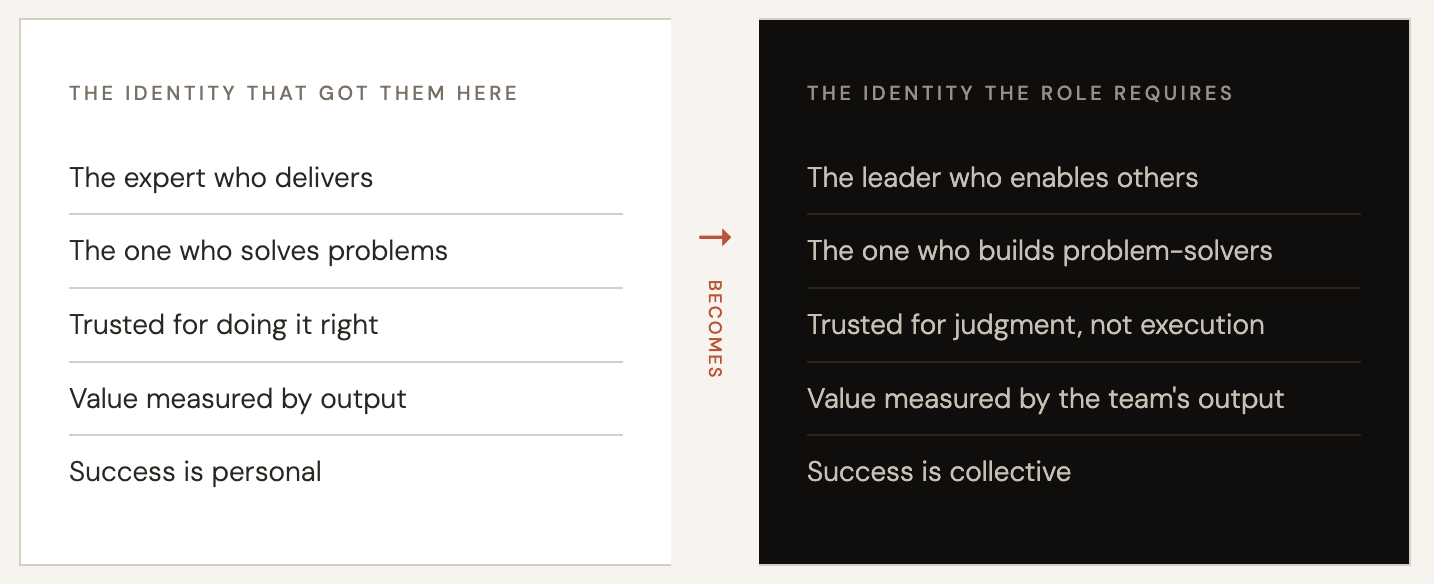
This isn't a minor recalibration. For many high performers, it requires letting go of the very things that defined their worth, and trusting that a new way of operating will work. Without support, most leaders don't make that shift cleanly. They keep one foot in the old identity while trying to inhabit the new one. And that gap is where transitions begin to stall.
How Identity Shows Up Under Pressure
The identity a leader carries doesn't just shape how they think about themselves. It shapes how they behave, especially when things get hard.
Under pressure, leaders don't rise to their aspirations. They fall back to who they believe they are. And for many high performers stepping into their first major leadership role, that means reverting to the patterns that built their career in the first place.
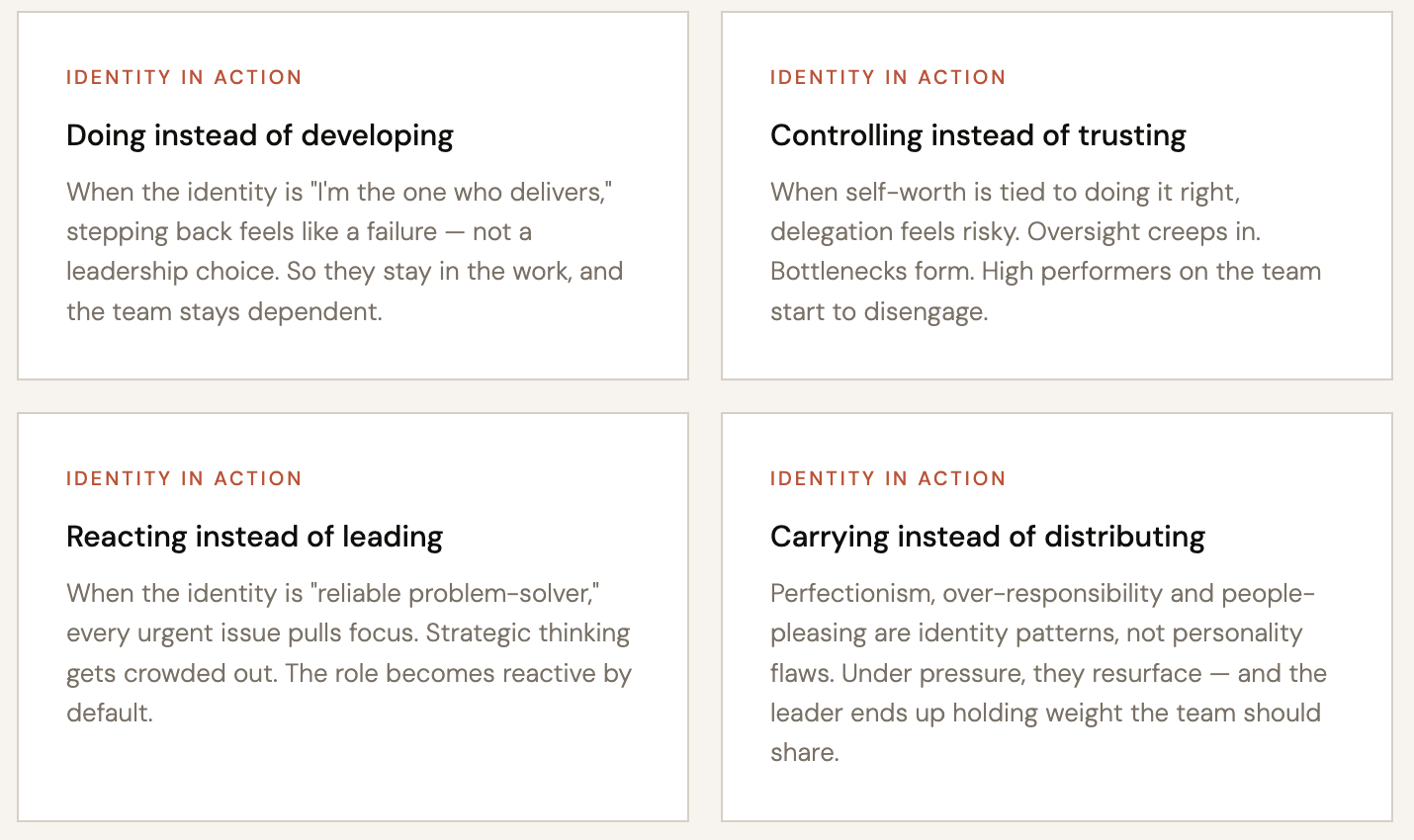
These aren't gaps in skill or knowledge. They're the shape of an identity that hasn't yet caught up with the role.
Why Leadership Programs Don't Solve This
Most leadership development focuses on the external, style, communication, executive presence, personal brand. These are valuable. But they sit on top of the identity, not underneath it.
You can give a leader all the frameworks in the world. If their internal sense of who they are and where their value comes from hasn't shifted, those frameworks won't hold under pressure. They'll know the right answer and still default to the old behaviour.
This is the gap. Not in the quality of the programs, but in where they start. Identity has to come first. Everything else builds from there.
When the Transition Stalls, Everyone Feels It
An unsupported leadership transition rarely stays contained to the individual. It moves through the team, the function and, over time, the organisation's pipeline.
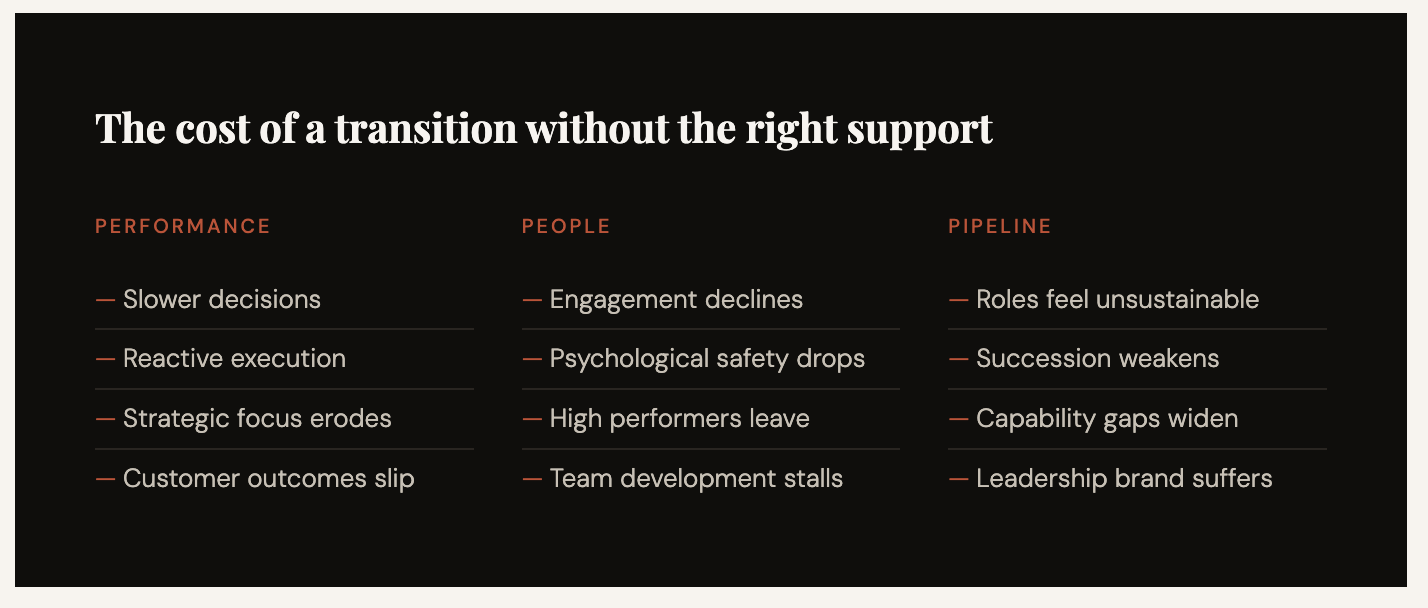
The leaders in these roles are not failing because they lack talent. They're failing because the transition asked them to become someone new, and no one helped them do that.
What a Successful Transition Actually Looks Like
The leader I mentioned at the start didn't leave. She stayed, and within a relatively short period, the same boss who had been frustrated with her became one of her strongest advocates again.
What changed wasn't her capability. It was her understanding of what the role required her to be. Once she could see the identity she had been operating from, the expert, the one who delivered, the person whose value came from knowing the answer, she could also see how that identity was shaping everything: her defensiveness, her difficulty letting others lead, the way she showed up under pressure.
That awareness gave her a choice she didn't have before. Not to abandon who she was, but to lead from a different place. To let her team's success become her success. To trust her judgment rather than prove her knowledge. To be the GM the role needed, not the expert the old role had rewarded.
The leaders who navigate transitions well share that quality. It isn't a particular style or set of skills. It's a clarity about who they're becoming, and the support to make that shift deliberately, rather than by accident or attrition.
That’s what coaching at the point of transition is designed to do.
Not add more capability, but accelerate the identity shift required for the role, so leaders can perform at the level they’ve been promoted into.
Is this the conversation you need?
If you've recently stepped into a senior leadership role, or you're noticing this pattern in leaders across your organisation, I'd genuinely like to connect. This kind of transition support changes outcomes. Let's talk about what it could look like for you, or your business.