
When stress becomes your default
A client came to me not long ago. A GM with over 20 years in retail, someone who had always thrived on the pace of the industry. The competing priorities, the politics, the pressure. It was part of what she loved about her work, and she was good at it.
But something had shifted. Small things were derailing her in ways they never had before. She was finding herself more and more frustrated with her team and key stakeholders. And at the end of the day, rather than switching off, she'd spend the evening going over how she'd shown up, replaying moments, criticising herself, unable to let it go.
Nothing at work had changed.
But something in how she was responding had.
She was going through perimenopause. Already on HRT and seeing some improvement, but not enough. The stress she had always been able to manage, she suddenly couldn't. Things that wouldn't have even registered before were now sending her into a reaction she couldn't seem to pull herself out of.
What struck me when we spoke was how she described it. She wasn't questioning her capability, she knew she was good at her job. What she'd lost was her sense of control over herself. And that, for someone who had built a career on being steady under pressure, was deeply unsettling.
Her story isn't unusual. I hear versions of it often. And what it points to isn't a performance problem. It's a capacity problem.
Why stress hits harder than it used to
Your brain's primary job isn't your performance, your reputation, or your career. It's your survival. And it doesn't distinguish between a real threat and a perceived one.
The restructure that hasn't been properly explained. The feedback that landed badly. The stakeholder who keeps moving the goalposts. To your nervous system, these register as danger, and the body responds accordingly. Tension. Shallow breathing. A racing mind. Irritability that seems to come from nowhere.
This is why so often capable, experienced women find themselves lying awake at 3am replaying conversations, or snapping at people they care about, or making decisions from a place of fear rather than clarity. It's not a character flaw. It's simply our wiring.
For many women in their 40s, there's an added layer. Hormonal changes that quietly lower the threshold. Stress that was once manageable suddenly isn't. Reactions that feel disproportionate, even to yourself. The frustrating part is that nothing obvious has changed. Which makes it even harder to make sense of.
Do you know how stress shows up for you?
One questions I ask the women I work with is: what are your early warning signs? Not the full overwhelm, the first signals that pressure is starting to build. Most of us have never stopped to think about it. We just find ourselves already in the deep end and wonder how we got there.
Stress tends to show up across three areas:
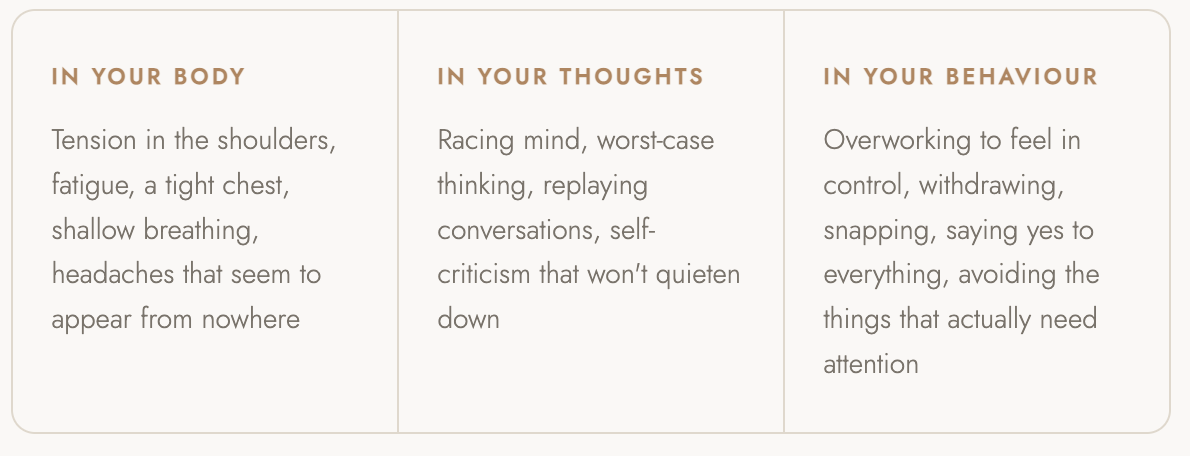
Getting to know your own pattern, without judgment, is where the work starts. Because you can't change what you haven't noticed.
The difference between reacting and responding
There's a moment, small, easy to miss, between something happening and how you respond to it. When we're stressed, we skip straight past it. The reaction is automatic, emotional, driven entirely by our protection system kicking in.
A response is different. It's intentional. Chosen. And the gap between the two is where your agency lives.
“Between stimulus and response there is a space, and in that space lies our freedom.”
The goal isn't to feel nothing. It's to widen that space just enough to make a choice you won't later regret.
I know from experience how hard that is when your nervous system is already firing. As the response feels so automatic, like a wave has just come upon you.
The Shift, an in-the-moment tool
This is where a simple, in-the-moment tool makes a difference. Not something complex, just something you can use when the reaction is starting to build.
Many of the women I work with already have solid nervous system practices, walking, breathwork, time out, that help across the week.
But in the middle of a day, when something happens and you feel the reaction rise, that’s where this matters.
Because your brain is wired for survival, it will move into a stress response quickly.
And without something to interrupt it, that reaction takes over.
This gave my client something to reach for in that moment.
A way to steady herself and feel back in control, even when everything around her hadn’t changed.
It takes less than a minute.
And it works because it doesn’t require you to have it all figured out first.
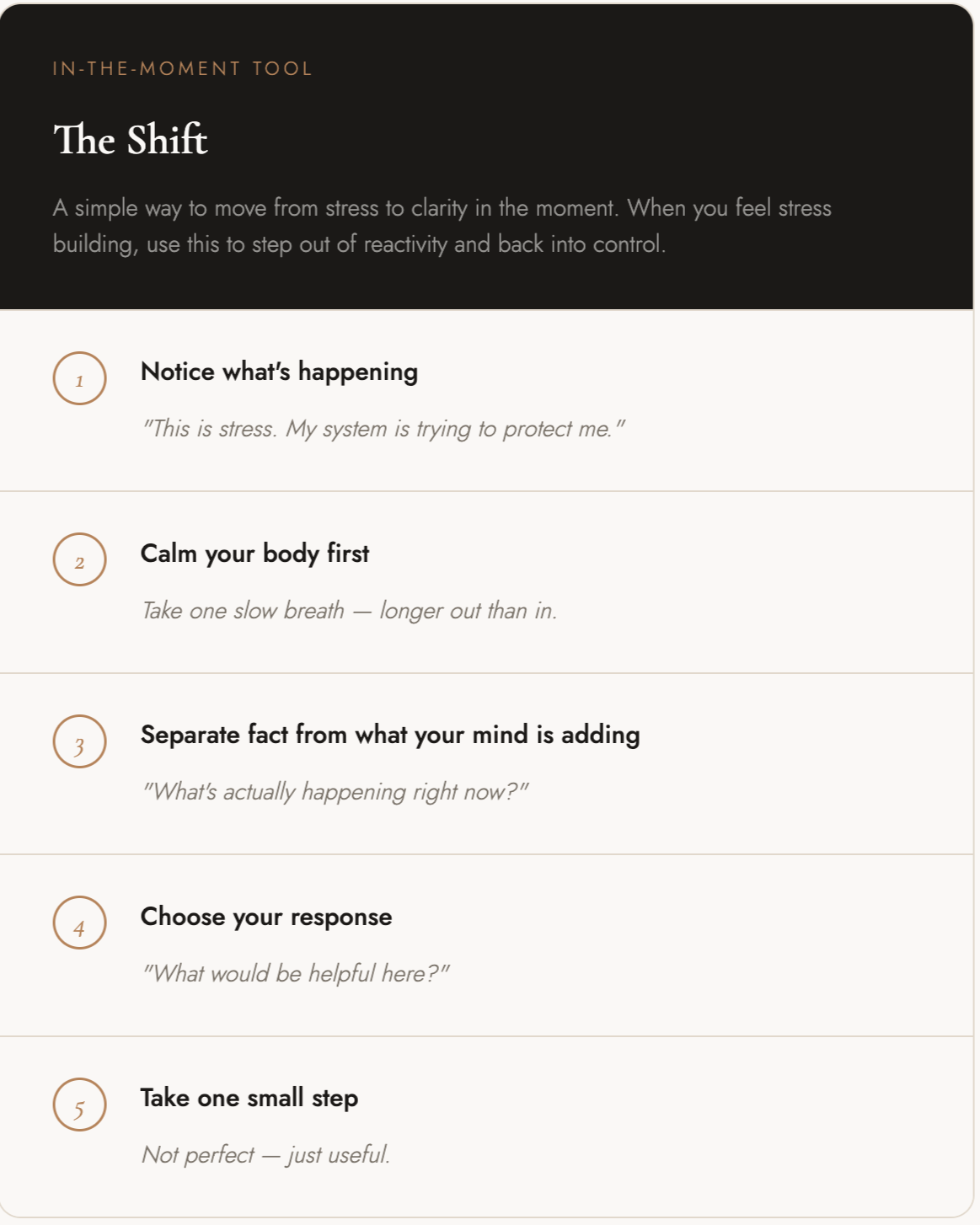
Here's what that looks like in practice. Your back-to-back meeting runs over. You're now late for the next one and you can feel the irritation rising, at the person who ran over time, at the afternoon that's now derailed, at yourself for not managing it better.
Reacting looks like: frustration, blame, mentally checking out of both meetings, carrying the resentment for the rest of the day. Essentially letting that one moment derail and impact the rest of your day.
Using The Shift looks like: noticing the tightness in your chest, taking one breath, asking what you actually know right now (one meeting ran over, that's it), and sending a quick message to the next meeting. Then refocusing.
The situation is the same. Your experience and the impact on the rest of your day is completely different.
The key is using breathe to help regulate, separating what actually happened…from what your mind is making it mean, and just focussing on the next best step.
That's where your power is, not in controlling what happens around you, but in choosing how you respond to it. Because it’s not just what’s happening that drives your reaction, it’s what you’re making it mean.
For my client, she knew her reactions were disproportionate, and so this gave her something to lean on in the moment, so she could feel more in control.
What this is really about
I am seeing so many women right now who are going through perimenopause, or who have been operating in a chronically stressed state for so long, that they've started doubting themselves as leaders. Questioning whether they're still cut out for this. Wondering how much longer they can sustain operating this way.
And it's a painful place to be, especially when you've spent decades building something, a career, a reputation, a way of showing up, that you were proud of.
But here's what I've come to understand, and what my client found too: fluctuating hormones and chronic stress don't create the problem. They reveal what was already lying underneath. The patterns, the inner critic, the story you tell yourself when the pressure gets too high.
This tool won't solve for all of that. But it will give you something to reach for in the moments when the reaction is already in motion, a way of detaching from the story just long enough to choose something different.
For my client, that was enough to start feeling like herself again. Not because everything became easier, but because she stopped being at the mercy of her own reactions.
That's what self-leadership actually looks like. Not having it together all the time. Just having something to come back to when you don't.
If this resonated, start small. Notice your early warning signs this week. Use The Shift the next time you feel the pressure building.
And if you want to go deeper, to understand the patterns driving this and change them properly, that’s exactly the work we do inside The Reset Method.