
Bravery Gets You Started. Courage Is What Changes Your Life.
Have you ever noticed that kids don't wait until they feel ready? They just go.
The first day of childcare, kinder, primary school, and soon, for my son, high school. Each one a step into something completely unknown, with no guarantee of how it goes. And they walk in anyway, not because they aren't nervous, but because waiting until they felt ready was never part of the equation. I marvel at it, the unremarkable bravery of small humans doing big things every single day.
But somewhere in adulthood, most of us lose that. Not completely, it still kicks in during the extreme moments, when our values are tested or when someone we love is at risk. When that happens, something instinctive takes over. I was reminded of this recently on a bushwalk at Bushranger Bay.
We were on a very narrow path, single file, dense shrub on either side. I was walking in front. We came around a bend and there it was, a huge brown snake, completely still, directly in our path. I am genuinely, viscerally terrified of snakes. And yet without thinking, without deciding, I moved myself in front of it and pushed my husband behind me to protect him. (I remind him of this often)
I wouldn't have predicted that response. Not in a thousand years. But one of my deepest values is protecting the people I love. And in that moment, my body knew exactly what to do before my mind had a chance to talk it out of it. Bravery, it turns out, tends to show up when it's needed most. The problem is that most of us are waiting for those extreme moments. We've forgotten how to be deliberately brave in the ordinary ones. And more importantly, we've confused bravery with something far more sustaining.
Bravery and Courage Are Not the Same Thing
When I left my corporate career to start my life coaching business, I needed to be brave. Brave enough to hand in my resignation. Brave enough to walk away from the salary, the title, the identity I had built over more than two decades.
Brave enough to say out loud, to myself and to everyone else, that I was doing something completely different with my life. I remember sitting at my desk on my last day thinking, what if I'm wrong about all of this? That moment of bravery was real. It was necessary. But here's what I didn't fully understand until I was on the other side of it.
The bravery was the easy part.
What has required infinitely more of me, every single day since, is courage. Courage to keep showing up when nothing is working yet. Courage to keep believing when the doubt is loud. Courage to fail, to learn, to adjust, and to go again, putting myself out there.
Courage to keep taking action when the momentum has stalled and the results aren't there yet and the comfortable, familiar life I left is still very much available to return to. Courage, I've come to understand, is not a single act. It's a daily practice.
The Year I Had to Choose Courage Every Single Day
In my first year of business I was showing up every day, taking action, doing the work and putting myself out there consistently. Clients were signing up, but the income was nowhere near what I had walked away from. And when you have spent twenty-five years building a career, a salary, a standard of living, the gap between where you are and where you were can be a little uncomfortable. I want to sit with that for a moment rather than rush past it, because it would be very easy to sanitise that experience into a neat lesson. But the truth is it was genuinely hard. The kind of hard that has you lying awake at night questioning every decision you've made. The kind of hard that makes the familiar, predictable life you walked away from feel very appealing.
The courage I needed in that period wasn't dramatic, it wasn't a single brave moment, rather it was quieter and more demanding than that. It was waking up every morning and choosing to believe that the business I was building was worth building, even when the numbers told a different story. That the gap between where I was and where I had been was temporary, not evidence that I had made a mistake. That the work I was doing was building something, even when I couldn't see it yet. And it was recognising, which did not come naturally to me, that courage doesn't have to be carried alone.
I reached out to a coaching community, people who had done what I was trying to do and some who were in the middle of it alongside me. I stopped telling myself I needed to figure it out independently and started understanding that seeking support wasn't a sign of weakness. It was how you strengthen your courage. You borrow from the belief of people who are further along the path until your own belief catches up.
That decision, to stop trying to be courageous alone, changed everything, and it something that I am now actively practising.
The Distinction That Changes Everything
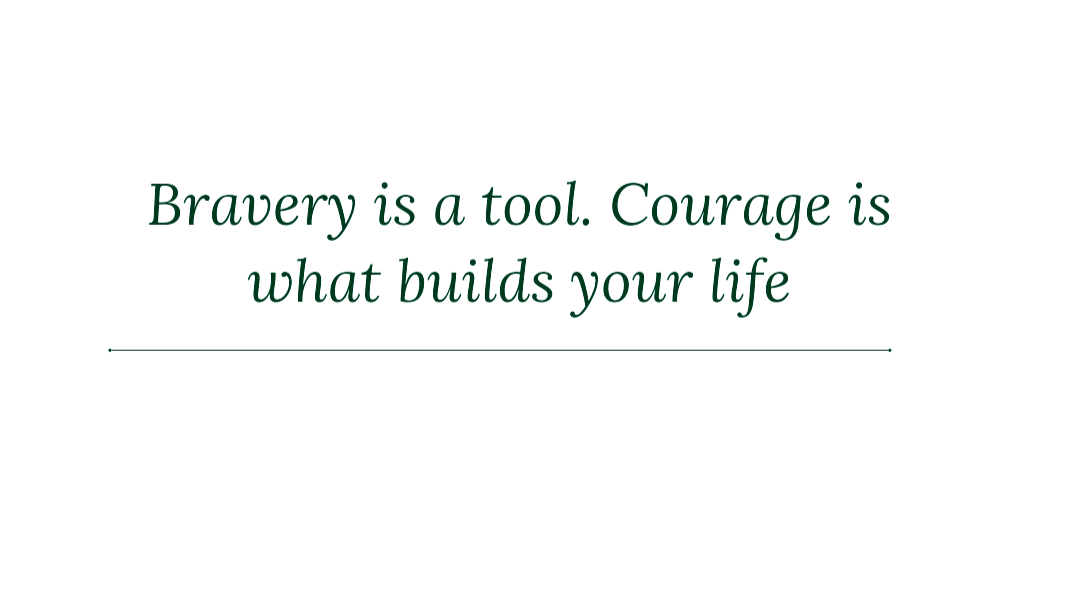
Here's how I've come to think about it. Bravery is a tool, it gets you across the threshold. It's the moment you do the thing you've been putting off, the resignation, the conversation, the decision, the leap. It's singular, defined, often visible to others. Courage is what builds your life. It's what happens after the leap. The continued choosing of discomfort over comfort. The not going back to what feels easier. The staying with something long enough that it stops feeling terrifying and starts feeling like you.
I've tracked this in my own life without meaning to. The bravery it took to leave my corporate career took one conversation, one letter, one day. The courage it has taken to keep going has shown up every single day since, sometimes multiple times a day. That's the ratio. One moment of bravery. Thousands of moments of courage.
Most people focus on being brave once, but change doesn't come from one moment. It comes from what you do after that moment, from choosing discomfort again, and again, and again, until the new thing becomes the normal thing.
Why Change Falls Apart After the Brave Moment
Many of the clients I work with are navigating significant change, perimenopause, career transitions, returning to themselves after years of putting everyone else first. Rebuilding their sense of identity and worth after burnout or illness or a life that stopped feeling like theirs, or no longer sustainable. Many of them have already been brave, they've made the decision, they've taken the first step, told someone what they want. And then, after a while, it falls apart, or stalls. Or they find themselves drifting back toward what was familiar, telling themselves it wasn't the right time after all.
This isn't a failure of bravery. They were already brave. It's a failure to recognise that what they needed next was courage. And that courage requires a completely different kind of support.
Bravery is often supported by a moment, a conversation, a decision, a push from someone who believes in you. Courage is supported by systems, practices, by the daily work of managing your thinking, regulating your nervous system, and staying connected to why you started when everything in you wants to stop.
If you've ever taken a brave step and then watched it slowly unravel, this is likely what happened. It wasn’t that you weren't capable, or the goal wasn't right. Rather it was that nobody helped you build the courage infrastructure to sustain it.
The Formula Nobody Talks About
If I had to put a number on it I'd say achieving the life you actually want takes one part bravery to every three parts courage. The bravery gets you in the door, courage keeps you in the room.
And the ratio matters, because most people spend their energy preparing for the brave moment and almost none preparing for what comes after. They look for support to take the leap. When what they actually need is support to keep landing, day after day, even when the landing is rough. So if there's something in your life that you want to change, a career, a relationship, a way of operating, a version of yourself you're reaching toward, I want to offer you a question worth asking yourself.
Is it bravery you need more of? Or is it courage? Because the answer changes everything about where you direct your energy and what kind of support will actually help you get there.
What Building Courage Actually Looks Like
Courage isn't a personality trait you either have or don't. It's built. Deliberately, consistently, through the practices and systems that resource you enough to keep choosing the harder thing.
For me that looks like nervous system regulation, making sure my body isn't running on chronic stress and cortisol, because a dysregulated nervous system is not a courageous one. It looks like managing my thinking consciously, catching the voice that says this isn't working and asking whether that's actually true or just an old pattern reaching for what's familiar. It looks like staying connected to my purpose, why I'm doing this, what it's actually for, especially on the days when the results don't reflect the effort.
And it looks like not carrying it alone. Reaching for the support of people who have walked the path before you. Borrowing their belief when yours runs low. Starting a business has tested every single thing I teach as a coach. There is no hiding when your own life is the evidence of your methodology. And what I can tell you from the other side of some genuinely hard days is this:
The bravery it took to leave wasn't nearly as demanding as the courage it has taken to keep going. And I wouldn't change any of it, because the courage is what built me.
Journal Prompts : Examining Your Bravery and Courage
Before you read these, I want to ask you to answer them honestly rather than quickly. The instinct for a lot of us is to move through reflective questions efficiently. That's the opposite of what these need.
Take the one that pulls at you most and spend ten minutes writing honestly.
Where in your life have you been brave but haven't yet built the courage to sustain it? What did the brave moment look like, and what has happened since?
What does your courage infrastructure look like right now? What practices, systems and support do you have in place to help you keep going when it gets hard?
Are you trying to be courageous alone? Who could you reach out to, someone further along the path, whose belief you could borrow while yours catches up?
What does your inner voice say on the days when progress feels slow? Is it telling you the truth, or reaching for what's familiar?
Is the support you're currently seeking helping you be brave, or helping you stay courageous? And is that the support you actually need right now?
The Brave Step Is Just the Beginning
My son will walk into high school soon, he'll be nervous, he might not sleep the night before and he will definately be feeling a lot of uncertainty. New teachers, new students, new school. But he will turn up on that first day anyway and that is the brave part.
What comes next, the showing up every day, the navigating the hard moments, the becoming someone he didn't know he could be, that's the courage part. It's not the bravery that will build him. It's what he chooses to do after it. And the same is true for all of us. Not just the ones who feel ready. Not just the ones who have it figured out. All of us, on the ordinary days, in the unremarkable moments, in the quiet daily choosing of the harder thing. That's where a life gets built.
And you don't have to build it alone.
If this resonated and you're ready to build the courage infrastructure to sustain the change you're trying to create, I'd love to have a conversation. You can book a free consultation with me here.